
From Warehouse to Stage: Rethinking Efficiency in LED Rental Operations
In large-scale rental, profitability is not built on individual rental fees but on how many times a fleet can complete the cycle from warehouse
22:29 01 October 2026
Ask any rental operator what determines whether a project makes a profit, and the answer rarely starts with pixel pitch or brightness on the LED rental display. It starts with efficiency — the hours between a truck leaving the warehouse and a screen going live on stage, the crew needed to assemble a wall before doors open, the turnaround window between one event and the next.
Image quality across mid-to-high-end rental LED products has largely converged. What still varies widely is how a screen moves through its operational life cycle: how fast it ships, how fast it goes up, how many times it can do that in a year before something wears out. This is the part of the business that doesn't show up in spec sheets, and increasingly, it's what separates profitable operators from struggling ones.
Efficiency Begins: The Weight and Build of the Cabinet Itself
Before a rental LED cabinet ever reaches a truck or a rigging point, its material and structure have already set a ceiling on how efficient the rest of the operation can be. Traditional die-cast aluminum cabinets work, but they're heavy. A single cabinet's weight seems manageable in isolation; multiply it across several hundred units and the consequences surface everywhere downstream — fewer cabinets per truck, more labor hours for handling, heavier rigging loads, faster wear on connecting hardware.
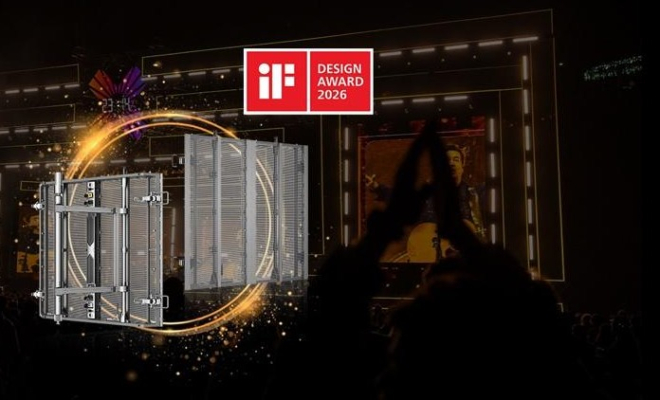
This has made material selection an operational consideration, not only an engineering one . YES TECH's MAir takes a different approach, using an industry-first carbon fiber integrated frame in place of die-cast aluminum. Since carbon fiber alone can't meet the load requirements of large-scale rental use, the frame is paired with a full-chain metal load-bearing structure, keeping panel flatness and overall strength intact while cutting significant mass. Wear-prone areas are finished with a blackened anti-abrasion treatment, which directly extends service life in high-turnover deployments.
None of this is visible to an audience. But a lighter, more durable rental LED solution means more units per truck, fewer crew for handling, and slower fleet degradation over time. The efficiency gains downstream all rest on this foundation.
Moving the Fleet: Transport as an Overlooked Efficiency Layer
Transport is one of the most underestimated cost centers in LED rental display. On paper, it looks like a simple logistics task — load the cabinets, drive them to the venue, unload. In practice, it involves repeated handling cycles, inconsistent stacking, and a steady rate of cabinet damage that shortens fleet lifespan.
For operators running dozens of projects a year — touring productions, large-scale stage events, sports venue installations — the hours lost to loading and unloading, along with the long-term cost of cabinet wear, can rival the cost of the installation itself. Most of this inefficiency traces back to generic transport solutions. Standard flight cases or general-purpose racks are rarely optimized for a specific cabinet design, which leaves space unused inside the truck and forces crews to spend more time securing each unit.
At YES TECH, the MAir solution addresses this with a dedicated transport cart built around the cabinet's dimensions, supporting a stacked configuration that fits 6 cabinets per cart. The cart connects to the cabinets through a bottom pin-lock mechanism, which shortens the coupling and release process considerably — a meaningful difference in scenarios where the same cabinets are loaded and unloaded multiple times per week.
This is also where the weight reduction from the carbon fiber frame starts paying off in practice. A stacked transport design on LED rental display is only viable if the cabinets themselves are light enough to stack safely; otherwise, rigging and handling requirements cancel out the space efficiency. Material, structure, and logistics form a single chain, and a weak link anywhere forces compromises everywhere else.
Assembly and Disassembly: Where the Schedule Is Won or Lost
If transport is underestimated, assembly is where the operational pressure becomes impossible to ignore. Large-scale rental projects often operate on load-in windows measured in hours, not days. Every design decision in the cabinet — how modules align, how locks engage, whether a single worker can handle a unit or needs a partner — translates directly into crew hours and schedule risk.
Traditional rental LED cabinets require careful visual alignment during assembly, screw-based locking, and module orientation that cannot be reversed. Each small inefficiency multiplies across several hundred cabinets, and a few seconds per connection becomes hours across the full installation. YES TECH’s MAir reduces this friction through a combination of design choices: magnetic positioning for fast alignment, pre-hanging structures that hold a cabinet in place before it is locked, and left-right interchangeable modules that remove the need to check orientation. The proprietary curved lock is designed for single-handed operation, with an auto-eject mechanism that speeds up disassembly as well.

Beyond speed, the cabinet also widens what's possible on the creative side — particularly in scenarios like commercial complexes, flagship retail installations, and concert stage design, where non-rectangular screen shapes are increasingly common client requests. MAir offers multiple cabinet sizes — 1000×1000mm, 500×1000mm, and 1000×500mm — which can be freely combined, offset in half-cabinet configurations, or joined at ±15° for curved surfaces and 90° for right-angle structures. What used to require custom fabrication — square columns, cylindrical screens, freeform stage elements — can now be built from standard stock.
This LED rental solution changes the definition of assembly efficiency: it is no longer only about how fast a flat wall goes up, but about how quickly a crew can build whatever shape a client request without specialized parts.
Wind Bracing and Maintenance: The Details That Decide Site Efficiency
Accessory hardware rarely gets attention in product discussions, but on site, it often accounts for a disproportionate share of delays. Wind bracing is a typical example. Traditional bracing systems rely on screw-based connections, which slow down both installation and teardown, and their fixed geometry makes them bulky to transport and store. On a tight schedule, a crew can finish the main screen build only to lose another hour securing the bracing behind it.
YES TECH’s MAir addresses this with a quick-release buckle design on the wind bracing, replacing screws with a mechanism that engages and disengages in seconds. The bracing also supports a folding structure, which cuts storage volume significantly and simplifies loading into transport carts. These are modest-looking changes, but they remove one of the last remaining bottlenecks in large-scale setup and teardown.
Maintenance follows a similar logic. In rental LED operations, response time on a failed module directly affects client trust, and the ease of replacing components matters as much as their reliability. Interchangeable left-right modules, quick-release locking, and standardized cabinet sizing all contribute to faster diagnostics and swaps in the field. None of this eliminates maintenance — it shortens the window between problem and resolution, which is what matters when a show is two hours from doors.
The Case for Treating Rental LED Display as a System
Taken individually, each of the design choices discussed so far produces a measurable but modest efficiency gain. A lighter cabinet, a faster lock, a quick-release brace, a transport cart sized to the fleet — in isolation, none of these would justify rebuilding an operational workflow around a new product.
The meaningful gain comes from integration. Efficiency bottlenecks in rental operations rarely sit inside a single stage; they sit in the transitions between stages — a cabinet waiting for rigging after coming off the truck, bracing starting only after assembly wraps, a failed module identified faster than it can be swapped. When transport, rigging, assembly, and maintenance are treated as separate problems, these transitions absorb the savings each stage produced on its own.
This is the gap YES TECH set out to close with MAir. Rather than optimizing a cabinet and leaving the surrounding workflow to operators, this rental LED display was developed as a full rental solution — cabinet, transport cart, locking mechanism, bracing, and maintenance workflow designed against one another from the outset.
For operators running high-frequency projects in large-scale venues, that system-level coherence is where MAir's operational value actually sits, and it is the basis on which YES TECH positions the product against conventional rental offerings.
MAir in the Field: Carpe Nox 2026, Albufeira
At Carpe Nox 2026, an outdoor electronic music event on the coast of Albufeira, Portugal, the MAir P7.8 transparent LED screen was deployed on the main stage, supplied by YES TECH's regional partner PIXEL LIGHT — Audiovisuais.
With load-in windows typical of coastal festival production, the lightweight carbon fiber cabinets reduced handling time and crew load during setup, while the single-handed curved lock and quick-release bracing compressed the assembly cycle further.
After the show, the same design allowed a fast teardown for the next tour stop. For PIXEL LIGHT, MAir's efficiency translated directly into a tighter production schedule and lower on-site labor cost.
Conclusion
In large-scale rental, profitability is not built on individual rental fees but on how many times a fleet can complete the cycle from warehouse to stage within a given year. Every design choice that shortens loading time, cuts crew hours, reduces cabinet wear, or simplifies on-site troubleshooting feeds directly into that turnover rate — and, ultimately, into margin.
This is the underlying logic MAir is built around. From its carbon fiber integrated frame to its dedicated transport cart, single-handed curved lock, and quick-release bracing, the rental LED product is engineered less as a display and more as an operational system for high-frequency, high-end deployment. For operators serving large-scale performances, sports venues, commercial complexes, and architectural media applications, that system-level approach is what makes MAir a practical answer to the efficiency pressures the rental market now faces.
To discuss how MAir fits into your specific project requirements or fleet planning, get in touch with the YES TECH today!